If there is a field that will forever be grateful to technology, it has to be the field of Medicine. It would seem in fact that from time immemorial, advancements in Medicine have been largely tied to advancements in health technology. Even before the invention of the medical syringe in 1863, and beyond the giant strides in robotic medicine today, this fact lives on.
If you disagree, then you should volunteer to have a painful surgery done without the use of anaesthesia. In fact, if you were born before the 19th century, that would be the only way out, as your only comfort would be to bite on a piece of wood.
Even though Wilhelm Conrad Röntgen discovered the X-Ray by accident in 1895, it has been intentionally used to save millions of lives in the past two decades. What about vaccinations for polio, measles, chicken pox; different birth control methods, In-Vitro Fertilization among others? The list goes on and on.
Ninety-five percent of all hearing aids are today 3D printed. Align Technology prints 650,000 pairs of Invisilign teeth-straightening braces a day. This tech is also pushing into prosthetics.
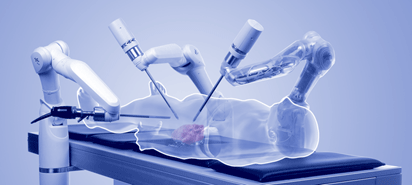
Enter Robotics. They aren’t just in the sci-fi movies, the robots are here. The da Vinci Surgical System for example,The da Vinci Surgical System for example, has performed over 20,000 operations since its 2000 debut. The more recent nanobots can swim through the bloodstream and scrape plaque from arteries.
However, it’s not all good news. A recent study into the safety of surgical robots now links the machines’ use to at least 144 deaths and more than 1,000 injuries over a 14-year period in the United States.
According to the study carried out by researchers at the University of Illinois at Urbana-Champaign, the Massachusetts Institute of Technology and Chicago’s Rush University Medical Center. 144 deaths, 1,391 injuries and 8,061 device malfunctions were recorded out of a total of more than 1.7 million robotic procedures carried out between January 2000 and December 2013.
Issues such as broken instruments falling into patients’ bodies, electrical sparks causing tissue burns and system errors making surgery take longer than planned.
Its authors say the number of injuries and deaths per procedure has remained relatively constant since 2007. But due to the fact that the use of robotic systems is increasing “exponentially”, they add, this means that the number of accidents is increasing every year. They highlight that when problems do occur, people are several times more likely to die if the surgery involves their heart, lungs, head and/or neck rather than gynaecological and urological procedures.
Although such a development might give cause for concern, the researchers instead of feeding fears, called for improvements in the field of robotics. The reasons might not be far-fetched; many of those surgical procedures might have in the first place, been next to impossible if not for robotics.

No comments:
Post a Comment